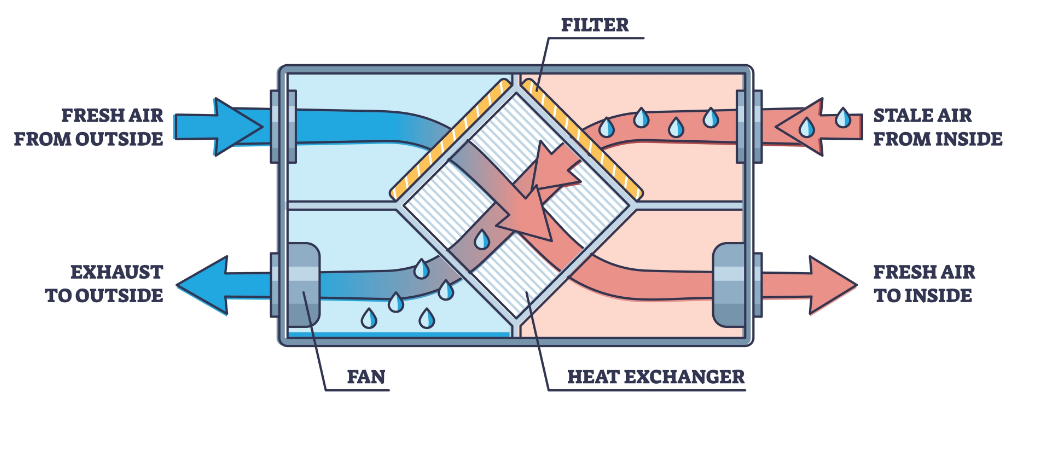
The HRV SystemComponents of an HRV SystemAn HRV system generally consists of the following equipment:
Figure 1
| ||||||||||||||||
Energy Recovery VentilatorsEnergy recovery ventilators, or ERVs, are a relatively new type of HRV that can exchange both heat and moisture. An ERV will give you more control over moisture levels in your home, which can be an important consideration depending on the local climate. Where winter climates are extremely dry, ERVs can recover some of the moisture that would be exhausted to the outdoors by a regular HRV. This can help you maintain a comfortable humidity level within the home, avoiding static electricity, sore throats and other discomforts caused by air that is too dry. During the air-conditioning season, on the other hand, ERVs can help keep excess moisture out of the home by extracting it from the incoming fresh air and transferring it to the exhaust air. Since less energy is required to lower the temperature of dry air compared to moist air, an ERV can reduce the load on the air conditioner and save you money. |
Air Distribution
There are two standard ways to distribute fresh air throughout the home – through ductwork installed specifically for the HRV (direct ductwork) or through the ductwork of a forced-air furnace system.
A direct-ducted system is commonly found in homes that do not have forced-air heating, such as those with electric baseboard, hot water or radiant heating. In this case, the fresh air is distributed through ducts to the bedrooms, living room, dining room, basement and other rooms, where it disperses throughout the house (see Figure 2). Exhaust air ducts take the stale air from rooms that have high moisture and pollutant sources back to the HRV and from there to the outdoors.
Figure 2
An HRV with direct ductwork
An HRV can also be installed to work in conjunction with a forced-air furnace system, as illustrated in Figure 3. In this case, the HRV's fresh-air duct is connected to the furnace's main return air duct. The fresh air enters the furnace and is distributed throughout the house using the regular system of ductwork. In such a configuration, the furnace blower should run continuously at low speed when the HRV is operating to ensure a regular flow of fresh air throughout the house. The furnace blower can also be wired to operate at the normal higher speed for heating and cooling. However, this higher speed can be noisy and may make the rooms feel cool if used to distribute ventilation air continuously. Separate, additional ductwork may be needed to transfer stale air from the damp rooms to the HRV (as shown in Figure 3).
Figure 3
An HRV installed in conjunction with a forced-air furnace system
*Furnace return air may come from more than one location.
Checking Airflow Room by Room
As a general rule, a direct-ducted system should provide at least as much airflow per room as shown in Table 2. An HRV system connected to a forced-air furnace distributes the fresh ventilation air to each warm air supply duct proportionally. Keep in mind that if you adjust the dampers in a forced-air heating system to increase or decrease ventilation airflow, you will also affect the amount of heat (cool air during summer) that reaches the room.
The Canada Mortgage and Housing Corporation has developed a simple technique to determine if each room connected via ductwork to an HRV system is being provided with the correct amount of fresh air. The technique requires a common household plastic trash bag (66 cm x 91 cm [26 in.x 36 in.]), a wire coat hanger, tape and a watch. Twist the coat hanger into a rectangular shape and tape the open end of the trash bag around the wire. Gently deflate the bag, place it over the air register and time how long it takes for the bag to fill with air.
Table 3 provides the approximate relationship between inflation times and airflow rates. Although this technique is not precise, it will help you estimate the rate of airflow to each room and allow you to make appropriate adjustments.
Table 3
Time to inflate a plastic trash bag
(66 cm x 91 cm [26 in. x 36 in.]
|
| |
| Airflow | Approximate time to inflate bag |
| 5 L/s (10 cfm) | 13 seconds |
| 10 L/s (20 cfm) | 8 seconds |
| 15 L/s (30 cfm) | 5 seconds |
| 25 L/s (50 cfm) | 3 seconds |
| If more air is required,adjust the grille openings at the supply register in the room.Keep in mind that bedrooms require more fresh air when occupied by more than one person. | |
The Need for a Balanced System
HRVs are designed to operate in a balanced state – the same amount of air should be drawn into the home as is being exhausted. An unbalanced system results in poor airflow and poor heat recovery and can lead to other problems, including an undesirable, continuous air-pressure difference between the inside and outside of your home.
System imbalance is usually caused by differences in the amount of ductwork used in the fresh air and exhaust air streams; however, imbalanced airflows may also be caused by a clogged filter, a blocked intake or exhaust hood, or a malfunctioning damper or fan.
Withdrawing more air from the house than comes in creates excessive negative pressure, as illustrated in Figure 4. Excessive negative pressure can cause spillage of carbon monoxide and other combustion by-products from fuel-burning appliances (e.g., a furnace, water heater or fireplace). Instead of leaving the house via the chimney, these combustion by-products can be pulled back into the house where they may be inhaled by occupants. Negative pressure can also increase the rate of entry of undesirable gases and moisture from the soil surrounding the basement (see Table 1, “Common pollutants and their sources”). Either scenario can threaten the health of the occupants.
Pulling more air into the home than is exhausted, or excessive positive pressure, can cause moist air from the home to be pushed into the walls and roof of the house, where it can condense and lead to deterioration of the building materials. This hidden problem often goes undetected until severe damage has been done. As well, moisture escaping through exterior door locks can freeze the lock mechanism, making it difficult to enter or leave the house. An imbalanced airflow can also cause the HRV core to develop frost or freeze, restricting or completely blocking further airflow (see “Considerations for Heating Season Operation”).
Finding a Contractor to Service Your HRVTo find a qualified HRV contractor, look under Heating Contractors or Ventilating Contractors in the Yellow Pages™. When you contact one of the companies listed, make it clear that you require the services of a residential mechanical ventilation installer who has been certified by the Heating, Refrigeration and Air Conditioning Institute (HRAI) of Canada. If you have difficulty finding a qualified contractor, contact the HRAI or, in Quebec, the Corporation des maîtres mécaniciens en tuyauterie du Québec (CMMTQ), at the addresses provided in the "Need more information" section. |
FIGURE 4
Effects of air pressure on a house
Although your HRV should have been balanced during installation, it is a good idea to have the system checked by a qualified contractor once a year. If you are purchasing an existing home that is equipped with an HRV, consider having the system serviced, including a balance test.
Do-It-Yourself Balance Check
You can perform your own rough check of your HRV's airflow balance using the plastic trash bag technique. In this case, tape the open end of an extra large trash bag (i.e., the type used for leaf collection) to a coat hanger. Place the deflated bag over the HRV's exhaust hood located on the outside of your house and time how long it takes for the bag to fill with air. Then hold the inflated bag over the HRV's air intake hood and time its deflation. On a well-balanced system, inflation and deflation times should be equal, within a matter of seconds.
Previous | Table of Contents | Next
Source: Natural Resources Canada (NRCan) - Office of Energy Efficiency